Our first pets were four laying hens that I had waited and planned for months in advance. I was excited to have these birds pecking and scratching away at our yard on insect control, just as Mother Earth News advertised. I wanted to give these animals a better existence than the factory farmer was willing to provide and feel good about where my eggs came from. I have seen miserable caged animals in the laboratory before, with no purpose other than to die. Personally, I believe that they understand their fate. Since leaving the lab behind, I'd prefer to dispatch critters only for my own subsistence with the exception that they are suffering.
It was my first project as a stay-at-home and soon-to-be mom and my very first experience with chickens. I brought the hens home from a local farmer late at night, as they return to roost and are easier to catch in the evening. The next morning I let them begin to roam the yard on my watch. Coincidentally, several hundred feet through the woods our neighbor was repairing some fence rails on his day off...with his birding dog. His dog spotted our White Rock scratching through layers of dead leaves. I heard the scuffle and squawk, then began to waddle at 8 months pregnant in the direction of the noise, making the mistake of leaving the remaining birds unguarded. A few minutes later and less than 24 h after bringing home our new additions, we were down to one hen and even I knew that she would be lonely. I returned to the farmer the very next day to purchase one more hen..."since we liked them so much." I didn't have the heart to tell her the gruesome story.
Since then and many birds later we have lost a total of 4 hens to dogs, 2 to hawks, 2 to fox, and 3 chicks to a raccoon. These do not include the near-miss encounters with a black bear, more hawks and other fox. We have a river corridor wildlife management area and bird sanctuary behind our home. Even the rectangular wire-encased runs that I built have proved insufficient at protecting our birds. The wildlife does quite well, which means free-range poultry is out of the question.
This season we expanded our interests to meat chickens, which proved especially difficult given our predation situation. I built a second coop for the birds to spend the night indoors, but this became problematic for several reasons. First, the birds had to be ushered out into a movable run in the morning and back to the coop at night. This sounds simple enough except that our spring group was comprised of the Cornish Cross commercial breed (this was the only choice our feed store offered), which are notorious for growing so fast that they become unable to walk, aside from other drawbacks. For a month, between when the birds feathered out and their slaughter, I had to catch and hand carry each bird back to the coop because they were unable to do so for themselves. Another problem with this type of management was the crowding that the birds had to endure overnight, not to mention the frequent cleaning that was required almost daily. I began to wonder if I was accomplishing anything more than the factory farm, besides an inefficiency that flirted with ridiculous.
After enjoying roasted homegrown chicken, I can say that we produced something considerably more palatable than what is available at the supermarket. Our birds enjoyed sunlight and dirt baths, but I aim to do better by them next time. My management plan for this fall season will be movable runs (24-30 sq ft) holding no more than 12 birds that are moved twice a day onto new pasture within a perimeter of electric fence for protection at night.


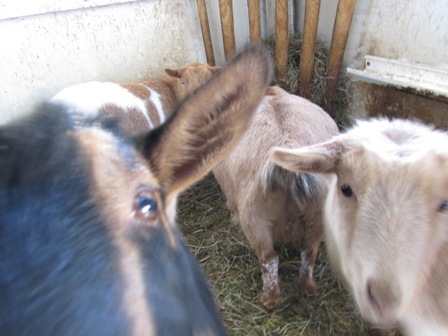
 Our goat kidding season will begin in less than three weeks! Although we will be warming, however temporarily, into the 40's this week, it's likely to still be around freezing when the babies arrive. Once the newborn kids have been dried off and received some warm colostrum, they will be comfortable. However, with goat birthing there will be quite a bit of watching and waiting on my part. I eschew gloves most days because I'm in a hurry, but after a few hours near freezing my hands start to get cold.